Classification:
Classification, which simply assigns a class to each instance annotation. For example, each sentence might be classified as having positive or negative sentiment, each word may get assigned a part-of-speech tag, or a document may be classified as being relevant to some topic or not. With classification, the parts of text are known in advance and assigned one out of several possible class labels.
Training Classification Model:
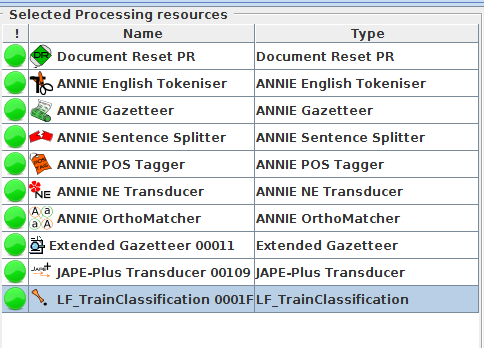
This is done by using LF_TrainClassification Processing Resource in gate.The classification training PR allows you to train a classifier suitable for problems such as language identification, genre identification, choosing which type to assign to named entities already located in the text and so forth. The PR has no init time parameters.
here we will consider an example for better understanding that is, ResumeHeading annotation is already located in the given text,so by using classification task we will find out the type of resume heading(whether its is related to education or work experience or skills or project or some other)
Run-time parameters:
algorithmParameters (String, no default) parameters influencing the training algorithm
dataDirectory (URL, no default, required) the directory where to save all the files generated by the algorithm (model file, dataset description file, information file etc).
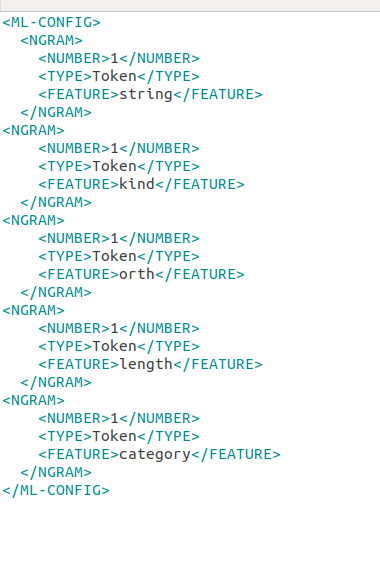
featureSpecURL (URL, no default, required) the XML file describing the features to use
In our example we are using only token features in the xml file.
inputASName (String, default is the empty String for the default annotation set) input annotation set containining the instance annotations, the annotations specified in the feature specification and the sequenceSpan annotations, if used.
instanceType (String, default “Token”, required) the annotation type of instance annotations.In our example it is "ResumeHeading".
instanceWeightFeature (String, no default, optional) leave it blank as of now
scaleFeatures (Enumeration, default NONE): set to none as of now
sequenceSpan (String, no default) this must be used for sequence tagging algorithms only! For such algorithms, it specifies the span across which to learn a sequence; for example a sentence is a meaningful sequence of words.
targetFeature (String, no default, required) the feature on the instance annotation that contains the nominal value which represents the class label. All instance annotations should have a class label.In our example we want the kind of resume heading so target feature is "kind"
trainingAlgorithm the classification training algorithm to use. We used LibSVM_CL_MR(non sequence algorithm) ,so we can skip specifying sequence span.

Run this pipeline over the training corpus and after training remove the training pr from the pipeline.
##Testing Classification Model:
Before going for testing the model with testing corpus ,make sure that testing corpus contain the annotation which is given as instance annotation type ,is present with required features in the set specified in inputASName
Now add LF_ApplyClassification Processing Resource to the pipeline to test the model obtained from training pr on the testing corpus.

###Run-time parameters:
algorithmParameters Parameters to pass on to the application algorithm, if any.
confidenceThreshold Leave it blank as of now.
dataDirectory The directory that was used to save the model during training.
inputASName The annotation set that contains the instance annotations and the annotations specified in the feature configuration file.
instanceType The annotation type of the instance annotations.
outputASName The annotation set where the prediction will be placed. If this is the same as the input annotation set, then the existing instance annotations will be updated, otherwise new annotation will be created.
sequenceSpan The annotation type for sequence spans if the classification algorithm is a sequence learning algorithm
serverUrl (String, no default) if specified, will try to connect to the given URL and use the server there to get the predictions.(not applicable now)
targetFeature Which feature to write the classification onto. Leave blank to put it in the feature that was learned at training time.

###Output:
our desired feature "kind" for "ResumeHeading" annotation will be created in the learning framework set using the instance annotation Type "ResumeHeading" ,now we can evaluate our feature with the feature of annotation present in default annotation set this can be done by using
Corpus Quality Assurance:[Click Here](http://127.0.0.1:8000/gate/eval_CorpusAssurance/#corpus-quality-assurance)

---
!!!Note
The topics which are not discussed now during the specification of run-time parameters of the PRs ,will be covered after learning the depth concepts in Machine Learning
---